 |
search | buy | contact |
 |
1922

PS 3535 U25 Al 7
The copyright page states that this book was "set up and electrotyped". The book itself ought to be laid down and forgotten. General rule is that poets with three names, just like assassins, are trouble. T.S. Eliot of St. Louis, Missouri published The Waste Land this year. His friend Ezra Pound, late of Idaho, edited.
1923
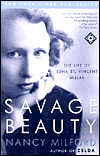
PS 3525 I495H3 1923b
I read the very first edition. The title poem is the Oedipus-tinged story of a poor boy with no clothes whose mother is found dead on Christmas Day after weaving her son an entire wardrobe from a magic harp. Dedicated to her mother. Good stuff. She was definitely a surprise to me-- I judged her by her name (the three name rule usually works). She was quite a jazzy rabble-rouser, according to a recent biography. I think that sometimes people who are alive think they're the only generation in the history of the world to have hot sex, but apparently these kids from the 20's knew what they were doing.
1924
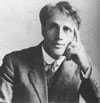
New Hampshire: A Poem With Notes and Grace Notes
PS 3511 R94 N4 1923
First publication of one of the world's most-anthologized poems; "Stopping By Woods on a Snowy Evening". It appears as a "grace note," a musical term for unnecessary embellishment, to the long poem "New Hampshire." The book itself is inexplicably dedicated to Vermont and Michigan. I read the 1936 seventh edition. Frost had a performance poet mentality in that he knew how to deliver the goods under pressure. When he recited at Kennedy's inauguration in 1961, he had prepared a brand new poem but couldn't read it because the glare of the snow was too much for him. So he recited The Gift Outright from memory instead.

1925

PS 3535 025 M33 1924
Big windbag narrative poem about some guy who died twice. Dedicated to two other people with three names-- James Earl Fraser and Laura Gardin Fraser. They are sculptors. Supposedly Teddy Roosevelt liked reading Robinson, who worked as a subway inspector in New York City for a while.
1926
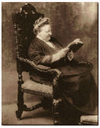
PS 3523 088 W5
The title is from Richard III. King Richard says, "Ay, what's o'clock?" Anyway this book is not that exciting and I thought it would be because I read some of her Imagist poems and they were great, especially the poem called " Patterns, " which appeared in "Some Imagist Poets" from 1916. Seems they gave her a Pulitzer late. Here's an excellent primer on Imagism, which is a precursor to American Performance Poetry in that it sought, like any other worthwhile poetry movement from Chaucer to Ginsberg, "use the language of common speech".
1927
PS 3537 P45 F5 1926
Read the book from the Harriet Monroe Collection at the University of Chicago, which I got via Inter-Library Loan at the Harold Washington Library Center. Monroe founded Poetry magazine here in Chicago in 1912. Some of the books in the U of C collection are from Monroe's personal library, with a lot of signed first editions. Uses a lot of three-line rhyming stanzas: She stole his mouth-- her own was fair--She stole his words, his songs, his prayer--/His kisses, too, since they were there."
1928

PS 3535 025 775
Giant poem retelling the King Arthur period myth of Tristam and Isolt. True to bourgeois form, it's dedicated to the memory of Edward Proby Fox. The third Pulitzer in seven years for this guy, and the MacMillan Company keeps publishing him again and again. Yech.
1929
PS 3503 E5325 J6
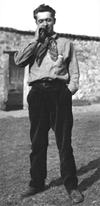
Long, narrative poem from the author of The Devil and Daniel Webster which tells the story of the Civil War through the eyes of John Brown, the radical abolitionist terrorist who raided an arsenal in Harper's Ferry, VA and was executed before the war. Three names. This guy couldn't carry Hart Crane's pencil sharpener. By the way, Hart Crane killed himself while on a Guggenheim fellowship, which we'll hear more about later. The thing about Crane is that he had guts and he made an earnest effort to create art that had relevance to readers. People like Benet should be competing for the Pulitzer prize for history and leave poetry to the poets.